


Improving your office Health and Safety

Office health and safety

When we think of health and safety, we often think of industries such as construction and manufacturing, whose work environments are typically littered with hundreds of safety hazards.

Offices are usually the last places we consider unsafe or potentially hazardous.

However, the latest figures show that around 10% (6,240) of all workplace injuries occurred within an office environment. We have compiled a short list of easy-to-implement tips to improve your office health and safety.

These tips will quickly boost workplace health and safety in the office when implemented well and will also aid in improving your organisation’s overall practices.


Removing trip and slip hazards
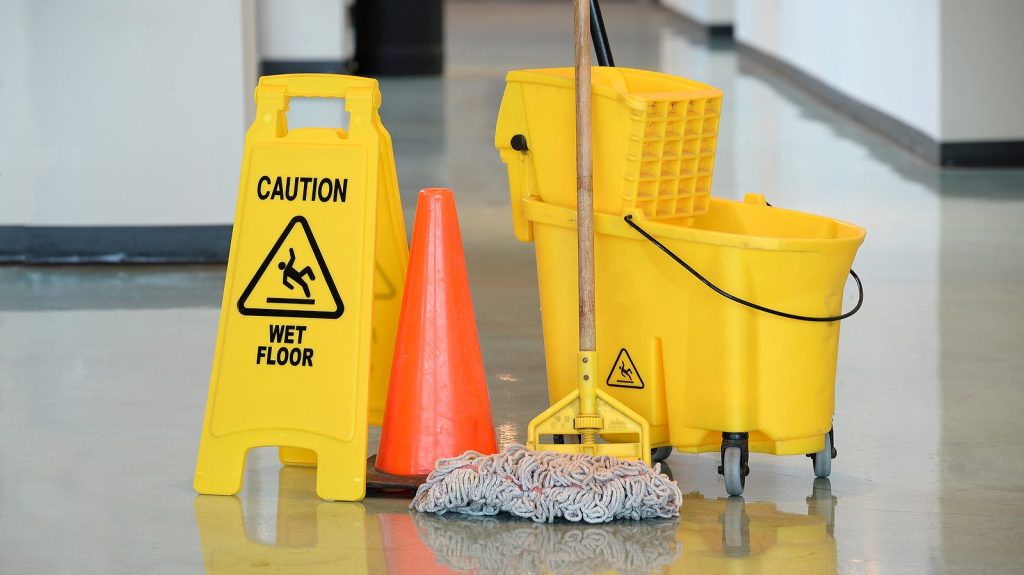
One of the easiest things you can immediately implement is removing trip hazards. Whether it’s an object in a walkway or a loose cable, fixing this minor issue can help prevent trips and falls, which are the leading cause of workplace injuries in the UK, according to the HSE (making up 30% of all injuries).

  • To prevent trip injuries, make sure all walkways are clear of objects, whether they be stray objects or loose cables. Removing these potential stumbling blocks is crucial in preventing accidents. 
  • Prompt cleanup is equally important because they’re not just unsightly but also a serious hazard. Swiftly cleaning up any spills eliminates slippery surfaces, which helps reduce the likelihood of slips and falls.
  • Well-organised cable management will also aid your overall safety, as it stops a loose cable from potentially being dragged into somebody’s way, creating a trip hazard. 
  • Anti-slip mats can also be a great option, particularly in entrances, providing an additional safeguard against slips. Additionally, making sure that the floors are kept dry minimises the risk of accidents.

Testing equipment regularly

Another simple step to enhance safety is thoroughly testing all your equipment, from wires to machinery. This will ensure that no faulty equipment is used, which could pose a health and safety risk, varying severity based on the problem.

Regular equipment checks are essential for maintaining office health and safety. These checks help identify potential hazards like malfunctioning equipment or damaged cords that could cause accidents such as electric shocks or fires. By conducting regular inspections, such incidents can be prevented, ensuring equipment functions properly. 

When inspecting, be sure to check for faults, wear, and damage. If any problems are found, the equipment must not be used due to safety hazards. It should also be removed to prevent others from endangering themselves. Only put it back into use when it is fixed to a high standard or replaced.


Electrical outlets

Regular checks for your electrical outlets are essential for maintaining a high safety standard. All employees must be aware of the risks associated with electrical outlets to prevent accidents and ensure a safe environment.

Some health and safety risks to watch out for include overloading outlets, putting liquids near electrics, and resting objects on outlets. These actions can lead to electrical hazards and pose severe risks to the workplace.


Fire Safety

Fire safety is one of the most critical aspects of workplace health and safety, as it threatens both lives and business operations. Therefore, it must be treated seriously and handled correctly.

Every office should have a designated fire marshal responsible for ensuring fire safety. Their role involves identifying potential fire hazards, implementing preventive measures, and establishing protocols to minimise fire risks.

Office health and safety involves ensuring the availability of functional fire extinguishers suitable for different types of fires, including those involving paper or electrical equipment. Additionally, it consists of overseeing the placement of clear exit signs and coordinating evacuation plans to guide employees to safety.

All employees should be trained in fire safety procedures, and fire alarms and smoke detectors must be checked and tested on a regular basis. Employees should also know their designated evacuation routes and any specific roles they may have during an emergency.

Our online fire safety training course can be accessed here.


Regular employee training

Health and safety training by Safesmart

Health and safety training by Safesmart.

Another straightforward tool you could implement in your workplace is regular training. This can be done online or physically and will ensure you and your colleagues know the correct procedures and safety measures.

Online learning, often called ‘e-learning’, is particularly convenient to implement. It saves time on travel and allows your organisation to schedule and monitor the training sessions in one place.

This will, therefore, keep everyone’s knowledge up to date, creating a safer workspace.


Employing The Right Software & Training

Using the right software and providing proper training is crucial when keeping your workplace safe.

Smartlog is an online tool that helps you keep track of everything related to fire safety and health & safety, all in one place. Whether you’re assessing risks, reporting accidents, or managing your premises, Smartlog has all the necessary features. It even offers online courses to keep your team updated on safety, complete with certificates and reminders. Smartlog makes it easy to maintain your workplace safely and compliantly.

We have created an online Health and Safety at Work course. This course provides more in-depth information about the office health and safety tips discussed in this article.


Health and safety in the office are vital for ensuring the well-being of employees and preventing workplace injuries. Despite the perception that office environments are inherently safe, statistics reveal a significant number of injuries occur within office settings. 

Implementing simple yet effective measures, such as removing trip and slip hazards, promptly cleaning up spills, organising cables, and using anti-slip mats, can significantly improve office health and safety standards.

Overall, implementing these quick tips will help to prevent injuries caused by common avoidable hazards. It will also bring awareness to the common hazards that you might not think of, which will make your office a safer environment to work.

To learn more about the other training courses we provide, click here.


Source

HSE (2023) ‘Index of data tables’. Available at: https://www.hse.gov.uk/statistics/tables/index.htm#riddor (accessed: 19/04/2023)

HSE (2023) ‘Health and safety statistics’. Available at: https://www.hse.gov.uk/statistics/index.htm (accessed: 19/04/2023)


Health & Safety Compliance in the Digital Environment

‘Convergence Culture’

“Ready or not, we are already living in a convergence culture” declared Jenkins (Convergence Culture, 2006) during another period of booming technological advancement – notably the dawn of the smartphone age. In broader culture the term ‘convergence’ had already been borrowed from Biology, adopted in Economics, Mathematics and Computing; generally alluding to a theory that basically describes a phenomenon where some creatures living in the same environment – although unrelated to each other, will eventually morph into a similar structure independently or develop identical traits.

In Telecommunications Policy (1998) several authors describe technological convergence along the aforementioned biological lines: multiple functions/technologies predicted to eventually share the same platform either for necessity or to increase efficiency. Fast-forward more than 20 years and the digital landscape has not failed to live up to lofty predictions, with the modern internet certainly boosting the speed in which progress has occurred.

Currently it has become expected that almost every electronic device serves multiple functions. For example the wristwatch can now receive and make phone calls alongside serving as a digital running and exercise companion – surprisingly the (then lauded) Fitbit was only launched in 2010. However for Q3 of 2018, Apple’s Smartwatch leapfrogged Fitbit for second place in global shipments and market share, achieving a year-over-year growth of 54% compared to Fitbit’s 3.1% shrinkage; an impressive feat for a company merely incorporating a related activity into their ‘smartwatch’ platform – convergence reaping benefits.

Convergence Meets Compliance

Health & safety compliance has also experienced convergence, albeit at a slower pace than larger culture. Any potential advancements in the industry are of course expected to be subject to – and limited by health & safety legislation and regulations; and this is important because legislation (primarily the Health and Safety at Work etc. Act 1974) created the government agency Health and Safety Executive (HSE) and gave them (to be more specific, the Secretary of State for Work and Pensions) broad powers in forming prosecutable health & safety regulations.

However the enhanced accessibility of up-to-date and indexed legislation online through the HSE’s information portals has meant that external consultation of health & safety law is in essence no longer needed. Realistically a medium to small company can compose its health & safety policy internally with minimal prior expertise. Along similar lines, the subject of data protection law which was passed as the GDPR in 2018 and the Data Protection Act of 1998 before that (addressed by Whenmouth previously here) has in practice converged with health & safety under the broad umbrella of compliance.

Compliance – or in this context: ‘regulatory compliance’, is simply about an organisation adhering to internal and/or external regulations for which incurred penalties range from a small fine to full-blown prosecution. So for example, a fire risk assessment and GDPR training for the organisation’s Data Protection Officer/s (both which are mandatory under current law) and tangible proof that these activities have been completed (eg. certificates) means that a singular system that logs, stores, and makes this proof immediately accessible trumps alternatively having multiple separate systems for this, especially for convenience and time-efficiency.

Increasing efficiency normally results in the reduction of business operating costs; and the emergence of software that has the capacity to incorporate various related activities under the compliance umbrella has been inevitable. Another example: Human Resources programs and Learning Management Systems (LMS) operate at different points along the compliance scale, but the desire to integrate related functions into a singular platform has seen the emergence and growth of software like Smartlog, which both manages compliance-relevant employee data and allocates mandatory e-learning courses to selected members of staff.

The Importance of a Core Competency

In order to successfully sell units, a highly capable product still needs credibility, especially one that has converged. Much like Apple’s branding retaining its credibility in the fitness and health watch market (as mentioned previously) or Samsung’s vast electronics experience massively contributing in their overtaking of Nokia as the market leader for mobile phone unit sales in 2012: a core competency is needed in order to retain any market credibility and successful integrate.

Amidst the integration of health & safety e-learning, risk assessment templates, site management alerts, logs, task allocation & monitoring, and (soon to be) asset management into Smartlog; Safesmart’s core competency lies in a history of fire safety engineering and consultations as well as an active fire risk assessment service that is up and down the country every week. It is a brand that puts fire safety at the top of the compliance pile, with the experience and expertise to back this up.

This is mainly because fire safety remains the heart of workplace health & safety, with 11,141 accidental non-residential fires attended by the Fire and Rescue services in England during 2017/18. These incidents resulted in 12 fatalities and 653 casualties with notably 2,245 (20%) of the fires occurred in offices/call centres, retail and hospitals/medical care; reinforcing both the ethical and legal need for all types of businesses to conduct a thorough fire risk assessment regularly.

Overall fire accident deaths only accounted for 8.3% of the 144 total workplace fatalities in 2017/18, however alongside the devastating personal injuries and losses of life, fire incidents by nature also more often result in copious amounts of property and asset damage of which very few businesses would be able to recover from financially.

Summary

According to HSE (2018) there has been a long-term downward trend in the rate of fatal injury per 100,000 workers since 1989, with the 2017/18 rate around a fifth (1/5) of the 1988/89 figures. So evidently workplace safety has improved over the years; and alongside the technological leaps and bounds in communications during the last couple of decades, improvements are also occurring in the delivery of health & safety compliance management and training, especially in regards to efficiency.

Convergence continues to drive innovations in the digital sphere and larger society, but with seemingly endless possibilities in the amount of different business management functions that can be potentially converged into a single platform, any limit will simply depend on the business and their compliance needs. But objectively some functions are more important than others, especially in relation to the law; which essentially means that across the board there is a one size fits all option.

Bibliography

Bohlin, E. (ed.)(1998) ‘Convergence and new regulatory frameworks: A comparative study of regulatory approaches to Internet telephony’ in ‘Telecommunications Policy Vol.22, Issue 10′. Elsevier

Jenkins, H. (2006) Convergence Culture. New York University Press

Forbes (2010) ‘Getting Fitbit’. Available at: https://www.forbes.com/2010/06/11/fitbit-tracker-pedometer-lifestyle-heatlh-lifetracking.html#124362215556 (accessed: 23/05/2019)

IDC (2018) ‘New Product Launches Drive Double-Digit Growth in the Wearables Market, Says IDC’. Available at: https://www.idc.com/getdoc.jsp?containerId=prUS44500418 (accessed: 23/05/2019)

Deloitte (-) ‘Regulatory & ethical compliance: Navigating through choppy waters‘ . Available at: https://www2.deloitte.com/uk/en/pages/audit/articles/regulatory-and-ethical-compliance.html (accessed: 30/05/2019)

GOV.UK (-) ’Fire safety in the workplace’. Available at: https://www.gov.uk/workplace-fire-safety-your-responsibilities/fire-risk-assessments (accessed: 30/05/2019)

GOV.UK (2019) ‘Fire statistics data tables’(Fire 0301 sheet). Available at: https://www.gov.uk/government/statistical-data-sets/fire-statistics-data-tables#non-dwelling-fires-attended (accessed: 28/05/2019)

HSE (2018) ‘Workplace fatal injuries in Great Britain 2018’. Available at: http://www.hse.gov.uk/statistics/pdf/fatalinjuries.pdf (accessed: 23/05/2019)

Contact Us

    This year's Sports Kit Sponsorship Grant is now OPEN for entries!